
Adams County Civil Docket Searches
Indiana Courts Case Search, MyCase opens nonconfidential Circuit and Superior records. Enter the exact case number when you have it. The Name tab works for a party or business name. Court, status, and filing dates then trim the results.
The prefix 01C01 marks Circuit, and 01D01 marks Superior. If the online docket search falls short, phone the Clerk at 260-724-5309, stop by 112 S. 2nd Street, Room A, email the completed form to clerksoffice@adamscounty.in.gov, or mail it to the office.
- Choose Adams Circuit or Superior.
- Enter the exact number or a narrow party name.
- Match court, date, type, and status.
- Read service, motions, settings, and orders in sequence.
- Ask the Clerk for complete or certified papers.
Adams Civil Codes Side by Side
Read any code together with its court prefix, filing date, status, service events, and final signed order. A broad label alone tells you little. SC stands for small claim and EV for eviction. CC is collection, CT is tort, PL is general civil, and MF is mortgage foreclosure. DC and DN cover domestic relations with and without children. ES and EU split supervised from unsupervised estates. PO, MH, and juvenile codes carry tighter access limits.
Small claims start in Adams Superior Court. Other civil and family cases are allocated by type and local rules. The full number beats a subject label every time. Read service before a hearing, and after a default or dismissal, read the final order.
Civil Dockets: What They Show
The CCS header lists case number, court, filing date, type, style, judge, and status. From there, the chronology can include the complaint, summons, service, answer, motion, conference, hearing, order, judgment, satisfaction, and appeal. A visible money line is not a certified current balance.
| Case Number | 01D01-YYMM-SC-###### gives court, date, type, and sequence. |
|---|---|
| Parties | Public plaintiff, petitioner, defendant, respondent, entity, and lawyer fields. |
| Filings | Complaint, petition, answer, service, and allowed images. |
| Motions | Requests, argument settings, and rulings. |
| Judgment | Judgment, dismissal, settlement order, default, transfer, or satisfaction. |
Adams Notice of Claim Steps
The county eviction page walks through how initiating papers build a civil docket. It requires an appearance, a Notice of Claim, information advisements, and ownership verification. A corporate claimant may need a resolution plus an attorney appearance. No hearing is scheduled until the required papers are filed.
The blank notice supplies court and party fields. It also covers property, grounds, amounts, hearing dates, and service data. And it warns about default for absence, evidence, jury-transfer timing, and continuance requests.
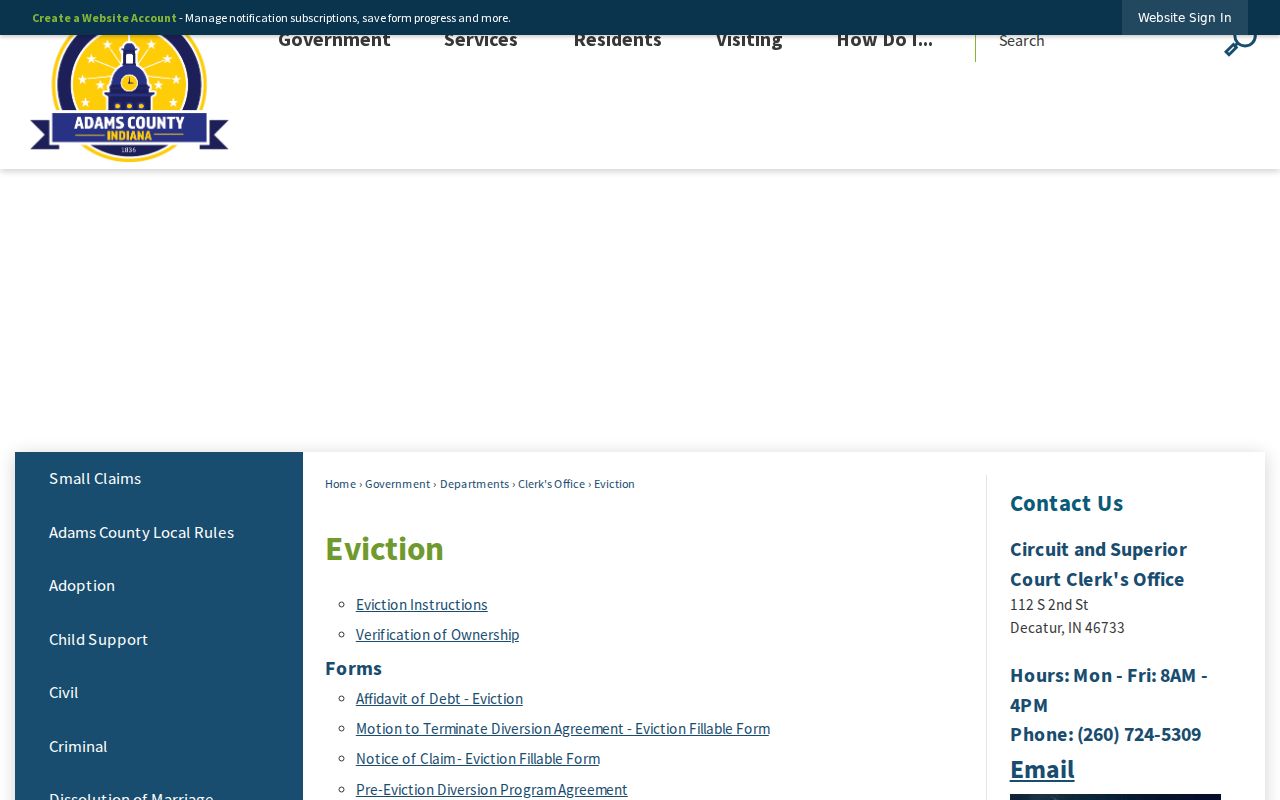
The successful assigned image connects the county’s required forms with later CCS entries.
What Cases Fill the Civil Docket
Adams civil work spans money claims, property, family, probate, and protective matters. Codes and access rules differ, so identify the category before judging what a public CCS should contain.
- Collections, torts, and general civil claims
- Small claims and eviction matters
- Mortgage, title, lien, and property cases
- Domestic-relations and support proceedings
- Estates, guardianships, mental-health, and protection matters
Adams Defaults Need Context
A default can follow a missed response or a missed appearance. Yet one default event is never the whole file. Read the proof of service, the hearing, the judgment, later motions, and any satisfaction. A setting order is not a judgment. A dismissal likewise needs its signed order and chronology. Official 2024 data list 103 default dispositions in Circuit. The same data list 204 in Superior across civil columns. Dismissed totals across all listed categories were 120 and 307. Those aggregates describe workload, not a named dispute, and they are not a case-level rate.
Service is the key dividing line. The CCS may list a summons issuance before any proof that service occurred. A later appearance, return, or service entry changes the procedural picture. A motion, conference, or hearing can then produce an interim order without deciding the claim. Follow the chronology through judgment and any post-judgment satisfaction.
Document access varies by code too. Public collections, torts, foreclosures, and plenary files may offer more images. Domestic-relations, protection-order, mental-health, and juvenile records allow narrower remote access. An order may be visible while a complaint is not. In that case, ask the Clerk what public copy can be supplied. A missing image never means no filing occurred.
Hearings on the Civil Docket
Read any setting with its date, time, location, description, and judicial officer. The Trial Court Calendar can show participating public hearings in its limited window. Still, the CCS and notice stay more complete. A reset only means the setting moved.
Check later entries for the replacement date. Local eviction instructions require written continuance requests five days before trial under that process, a rule that does not govern every matter. The Adams County court schedule explains the public calendar.
Adams Certified Civil Judgments
The Clerk's copy form asks for the document title and date. It also requests case number, parties, number of copies, certification choice, and delivery method. A completed form can travel by email, mail, or hand. Certified copies go out after payment.
The form states $1 per page and $3 per document certification. The office calculates the total and promises no fixed processing time. Need a current balance, credit, judgment satisfaction, or official paper? Clerk confirmation controls over a MyCase snapshot.
Who Can See Civil Dockets
Indiana starts from public access, but online coverage differs. Nonconfidential CC, CT, MF, and PL files may show more images than domestic-relations, protection-order, mental-health, and juvenile categories. Not online does not mean nonexistent. Ask the Clerk whether counter inspection or copies are public.
Key Rules:
Access Rule 4 states the general public rule.
Access Rule 5 protects excluded material and personal information.
Access Rule 9 supplies a verified request route in extraordinary circumstances.
A closed case is not automatically sealed. A public caption does not make every document public either. Use precise access terms backed by the CCS, the Clerk, a rule, or an order.
Adams Civil Records After Odyssey
Adams County civil files live in Odyssey once they are filed. The Indiana Courts Portal sends every filed paper there, and MyCase opens it to the public. But public view is a narrower window than what attorneys and parties see. A filing can be valid and appear in the CCS. Still, it can show no image to an ordinary user. Older events imported during conversion can lack images too. So search by case number. Copy the exact filing description and date. Then carry those details to the Clerk's copy form.
Read a civil docket in order. The initiating paper comes first, then the service record, then the response, the hearing, and the final order. Codes help, but only so far. An SC code marks a small claim without telling you whether service succeeded or judgment was entered. An EV code flags an eviction. But it says nothing about confidential diversion, whether a first hearing happened, or whether damages were set later or the case was dismissed. In a collection file, a judgment line alone does not prove the balance is still unpaid. Check later credits and satisfaction entries before assuming anything.
Fees shift with time. So trust the current county schedule over the older small-claim manual, which still showed a 2021 cost. Today the schedule lists $87 to file a small claim or eviction electronically and $97 on paper. Sheriff service runs $28 before judgment and $28 after judgment. Those are filing and service costs, not a fee to run an ordinary MyCase search. Confirm the amount with the Clerk before you file, since a dated manual can lag the active schedule.
A complete copy request names the court and the case number. Add the parties, the document title, and the filing or order date. Also include the copy count and say whether you need certification. The Clerk returns ordinary copies through the documented delivery channel and mails certified copies after payment. The office posts no fixed turnaround. Plan around your court deadline and ask rather than assuming same-day service.
Adams Circuit and Superior joined Odyssey on August 19, 2019. Odyssey now powers the CCS, calendars, fee history, images, and MyCase public view. Some imported events carry a converted label, and older images can be incomplete. That history matters. It explains why an older paper may seem missing from an Adams County court docket that is otherwise complete.